
At some point, every growing services firm hits the same wall. Referrals aren't enough, the founder is too busy delivering client work to prospect, and somebody needs to be filling the top of the pipeline. (If this sounds familiar, we wrote a full breakdown of why services firms get stuck in this pattern.) The obvious-sounding answer: hire an SDR.
We'd argue it's the wrong first move for most services firms. Not because SDRs are bad — they're not — but because the math and the timing rarely work out the way firm owners expect.
Here's the honest breakdown.
What an In-House SDR Actually Costs
When services firm owners think about hiring an SDR, they usually think about salary. "I'll find someone hungry, pay them $45K-$50K plus commission, and they'll fill my calendar with meetings."
That's the fantasy. Here's the reality.
Base salary: $45,000-$55,000 depending on your market. In major metros, you're looking at the higher end. In smaller markets you might find someone for less — but you'll also have a smaller candidate pool and, candidly, less experienced options.
Benefits and employer costs: Health insurance, payroll taxes, 401(k) if you offer it. Add 20-30% on top of the base. That $50K salary is really $60-65K.
Tools and subscriptions: Your SDR needs a CRM (if you don't already have one), an email sequencing platform, a data provider for prospect lists, LinkedIn Sales Navigator, a calendar booking tool, and probably a phone system. Budget $300-$500/month — and that's on the low end. Some of these tools have annual contracts, so you're committed even if the hire doesn't work out.
Sending infrastructure: If your SDR is doing cold email — and they should be — they need secondary sending domains, warmup tools, and email deliverability monitoring. This isn't optional. We've seen firms let SDRs send cold outreach from the company's primary domain, tank their sender reputation, and then spend months trying to recover it. Setting up proper infrastructure takes knowledge most first-time SDR hires don't have. (We cover what proper cold email infrastructure looks like in our cold email guide.)
Management time: This is the big one that nobody budgets for. An SDR doesn't manage themselves — especially not in the first 6 months. Someone (usually the founder) needs to set targets, review emails (do you know what good cold email copy looks like?), listen to calls, course-correct messaging, and hold the SDR accountable. If you're spending 5-8 hours a week managing your SDR, and your billable rate is $200/hour, that's $4,000-$6,400/month in opportunity cost. Nobody puts this in the spreadsheet. But it's real.
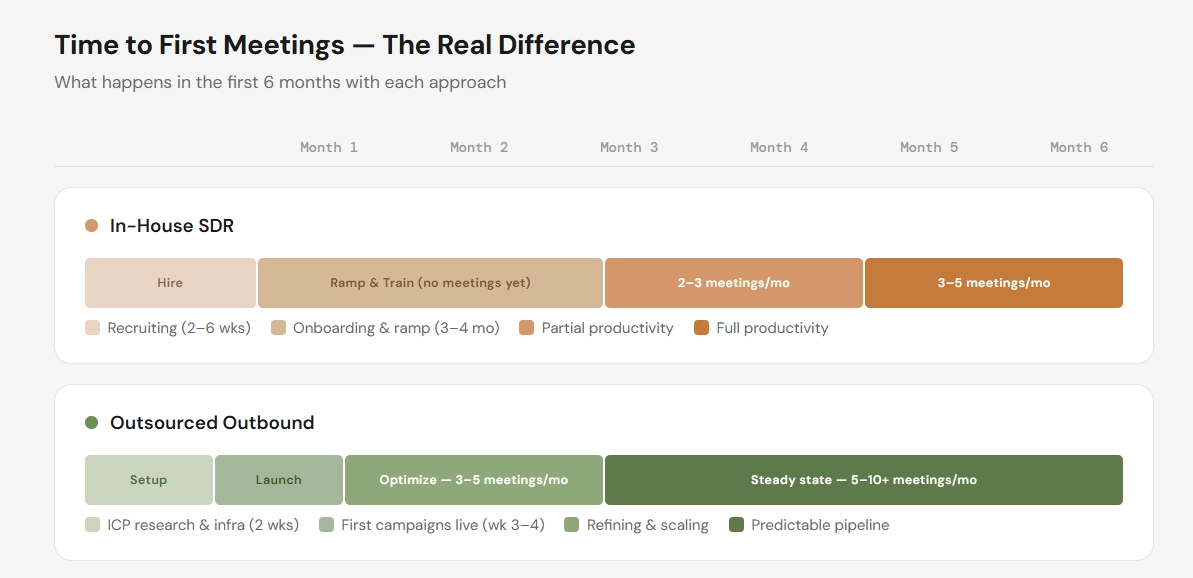
Ramp time: Industry data puts average SDR ramp time at 3-4 months. For a services firm — where the SDR has to learn a technical service offering, understand buyer psychology in a specific vertical, and build lists from scratch — it's often longer. During ramp, you're paying full cost for partial output. Realistically, don't expect meaningful meetings until month 3 or 4.
Add it all up: A conservative year-one estimate for one in-house SDR at a services firm is $65,000-$85,000 all-in. That includes salary, benefits, tools, infrastructure, and the opportunity cost of management time. And that's assuming they stay.
The Number Nobody Talks About: Turnover
Average SDR tenure across industries is about 14-16 months. That's not a Firmwise stat — it's widely reported across sales industry research. And for services firms, it can be worse. SDRs at 15-person MSPs or staffing agencies don't have clear career paths. There's no "Senior SDR" role to get promoted into, no AE team to graduate to. Good SDRs get bored or get poached. Bad SDRs get let go.
When an SDR leaves, you lose the pipeline they were working. You lose the institutional knowledge about what messaging resonated and what didn't. You're back to square one — recruiting, onboarding, ramping — while your pipeline goes dark for 3-4 months.
The cost of one turnover cycle has been estimated at $100,000+ when you factor in lost productivity, recruiting costs, and the pipeline gap. For a small services firm, that's not just a budget hit. It can stall your growth for an entire quarter.
What Outsourcing Actually Costs
The outsourced outbound market is broad. Giant agencies charge $8,000-$15,000/month with 6-month commitments. On the other end, you'll find offshore freelancers sending bulk email for a few hundred dollars a month (don't do this — your domain will be toast within weeks).
For services firms specifically, here's what a well-structured outsourced engagement looks like:
Pilot phase: $2,000-$5,000 one-time. A defined test — one ICP, one campaign, clear deliverables. At Firmwise, our pilot is $2,500 and includes ICP research, a verified prospect list of 1,000+, dedicated sending infrastructure, custom email sequences, and full response handling. The point of a pilot is to prove the model works for your firm before anyone commits to ongoing spend.
Ongoing retainer: $3,000-$5,000/month for a focused program. This should include continued list building, campaign management, A/B testing, and meeting booking. At that price range for services firms, you should expect 5-10+ qualified meetings per month at steady state.
What's included that you'd pay separately with an SDR: The tools, the data, the infrastructure, the expertise. An outsourced partner brings their own tech stack, their own sending infrastructure, and — critically — the operational knowledge that takes an in-house SDR months to develop. There's no ramp time because the team has already run dozens of campaigns for firms like yours. This gap is even wider in verticals with fragmented contact sourcing — like K-12, where school decision-makers don't exist in any standard sales database. An outsourced partner has already solved the sourcing problem; an SDR starting from scratch will spend weeks just building a usable list.
The Side-by-Side Math
Let's make this concrete. Here's what year one typically looks like for a services firm:
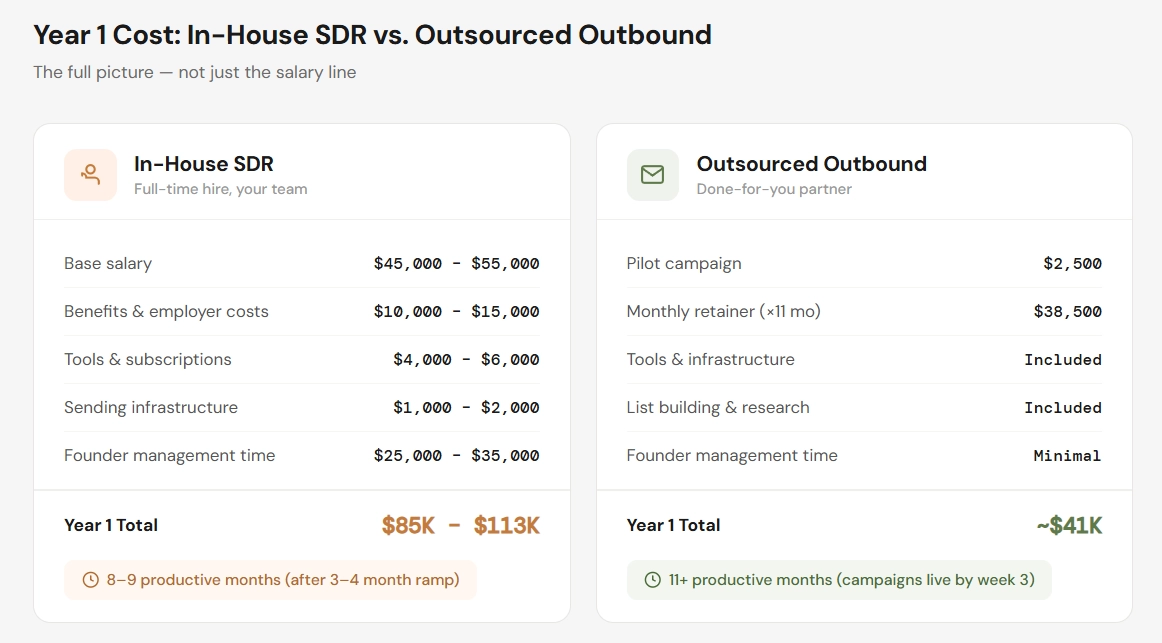
In-house SDR — Year 1: Salary + benefits: ~$60,000-$65,000. Tools and infrastructure: ~$5,000-$7,000. Founder management time (conservatively): ~$25,000-$35,000 in opportunity cost. Productive months generating meetings: maybe 8-9 out of 12 (after ramp). Risk of turnover resetting the clock: real.
Total: $90,000-$107,000 for 8-9 productive months.
Outsourced (Firmwise model) — Year 1: Pilot: $2,500. Monthly retainer (11 months): ~$38,500. Founder management time: minimal — you show up to meetings and give feedback.
Total: $41,000 for 11+ productive months.
That's roughly half the cost with more productive months. And if it's not working after the pilot, you're out $2,500 — not $40,000 and six months of your time.
But It's Not Just About the Money
The cost comparison is stark, but there are real reasons to hire in-house that go beyond dollars.
You build internal capability. An SDR on your team learns your business deeply. Over time, they can handle inbound leads, help with proposals, even grow into a business development manager. An outsourced partner doesn't build that internal muscle.
You maintain full control. When the SDR sits in your office (or on your Slack), you can adjust messaging in real time, pivot targeting on a dime, and ensure every email matches your brand voice perfectly.
There's long-term economics. If you find a great SDR who stays for 2-3 years, the unit economics can flip. A fully ramped, experienced SDR who knows your business inside and out is hard to replicate with any outsourced model.
We tell firm owners this honestly: if you have the management bandwidth, the sales infrastructure, and the ability to absorb a 3-4 month ramp period with no meetings, hiring in-house can absolutely work. The problem is that most services firms don't have those things — especially the first time around.
When Each Option Makes Sense
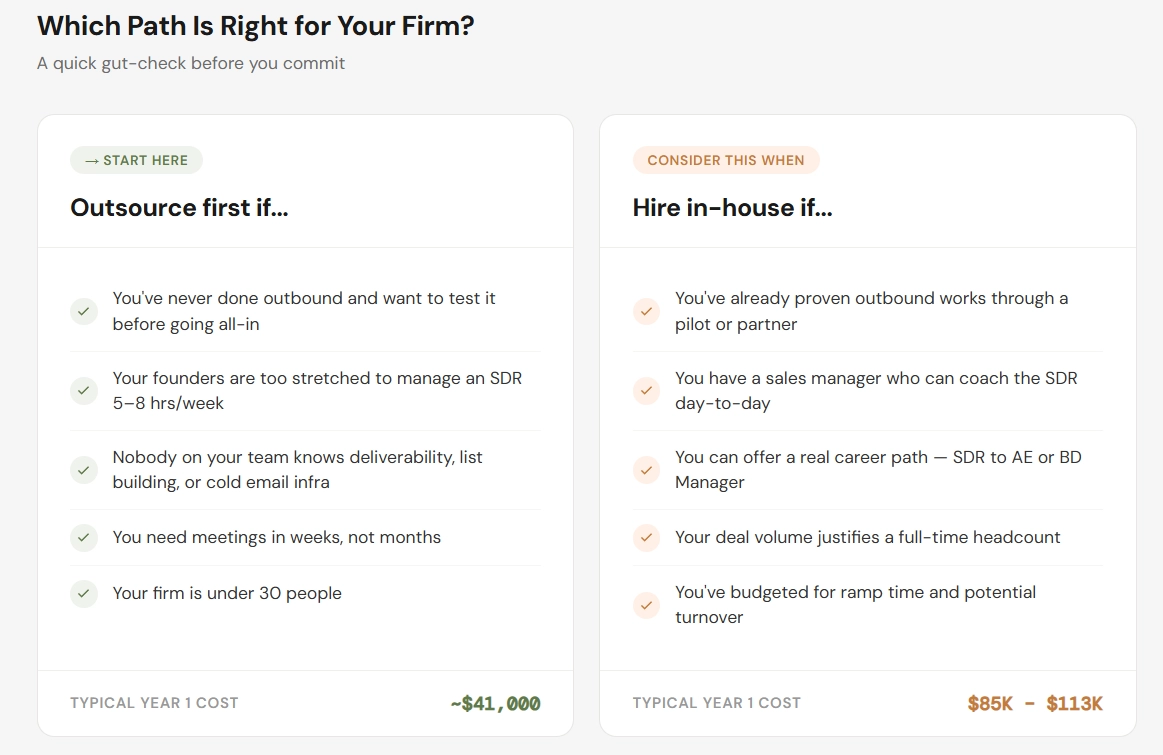
Outsourcing makes sense when: You've never done outbound before and need to validate the channel before investing heavily. You don't have the internal expertise to manage sending infrastructure, deliverability, and list building. Your founder or partner team is already stretched and can't dedicate 5-8 hours/week to SDR management. You want meetings in 4-6 weeks, not 4-6 months. You're a firm under 30 people — you likely don't have the internal structure to support a dedicated sales hire.
Hiring in-house makes sense when: You've already proven outbound works (ideally through a pilot or outsourced engagement) and want to bring it in-house. You have or can hire a sales manager to coach and hold the SDR accountable. You have a clear career path to offer — SDR to AE, or SDR to Business Development Manager. Your deal size and volume justify a full-time headcount. You've budgeted for the full cost, including ramp time and potential turnover.
Here's the pattern we see most often with our clients: they start with an outsourced pilot to prove the model, run it for 6-12 months to build a predictable pipeline, and then some bring outbound in-house once they understand exactly what works. Others keep outsourcing because the economics and the time savings just make more sense at their scale. Either path is fine. The worst path is hiring an SDR as your first move, watching it sputter for six months, and concluding that "outbound doesn't work for services firms." It does. You just started with the most expensive, slowest, and riskiest way to find out.
Our pilot is $2,500 — one campaign, 5-meeting guarantee, and you own everything we build. Book a call to see if it's a fit.