
We talk to companies that sell to schools almost every week — EdTech platforms, school supply distributors, safety and security vendors, IT services providers, furniture companies, you name it. The conversation usually starts the same way: "We tried cold email. It didn't work."
When we dig into what happened, it's almost never a messaging problem. The emails were fine. The offer was real. The product or service genuinely helps schools. But the campaign flopped anyway — high bounce rates, low replies, wasted months.
The reason is simpler and more frustrating than most people expect: they couldn't find the buyers.
The Contact Problem Nobody Talks About
If you sell to, say, marketing directors at mid-market companies, your life is easy. Open Apollo or ZoomInfo, filter by title and company size, export 5,000 verified contacts, and start writing emails. The infrastructure for finding B2B buyers is mature and reliable.
Now try that for schools.
Search for "superintendent" in Apollo. You'll get a handful of results — maybe a few hundred across the entire country, most of them outdated. Search for "principal" and you'll get a mix of school principals and people with "principal engineer" in their title. Search for curriculum directors, procurement leads, or district IT directors and you'll get almost nothing.
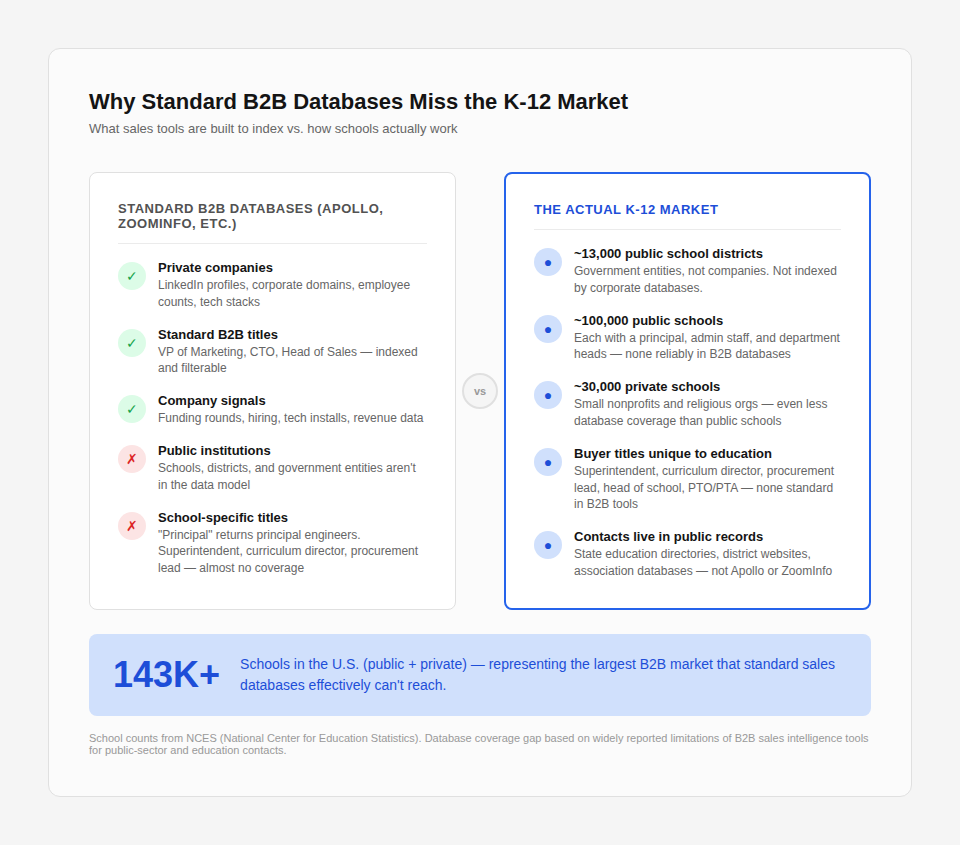
This isn't a bug in the tool. It's a structural gap. Schools — public and private — aren't organized like companies. Public schools are government institutions. Private schools are often small nonprofits or religious organizations. Neither type has LinkedIn company pages with employee counts. Neither shows up reliably in the business databases that index private-sector companies. The ~13,000 public school districts, ~100,000 public schools, and ~30,000 private schools in the U.S. operate in a parallel universe from the standard B2B ecosystem.
And that's where outbound to schools breaks down — not at the messaging stage, not at the deliverability stage, but at the very first step: building a list of people to contact.
What Most Companies Selling to Schools Actually Do (And Why It Doesn't Work)
We've seen the same pattern play out dozens of times. A company that sells to schools decides to build an outbound motion. They hire an SDR or engage a general-purpose lead gen agency. Then one of two things happens.
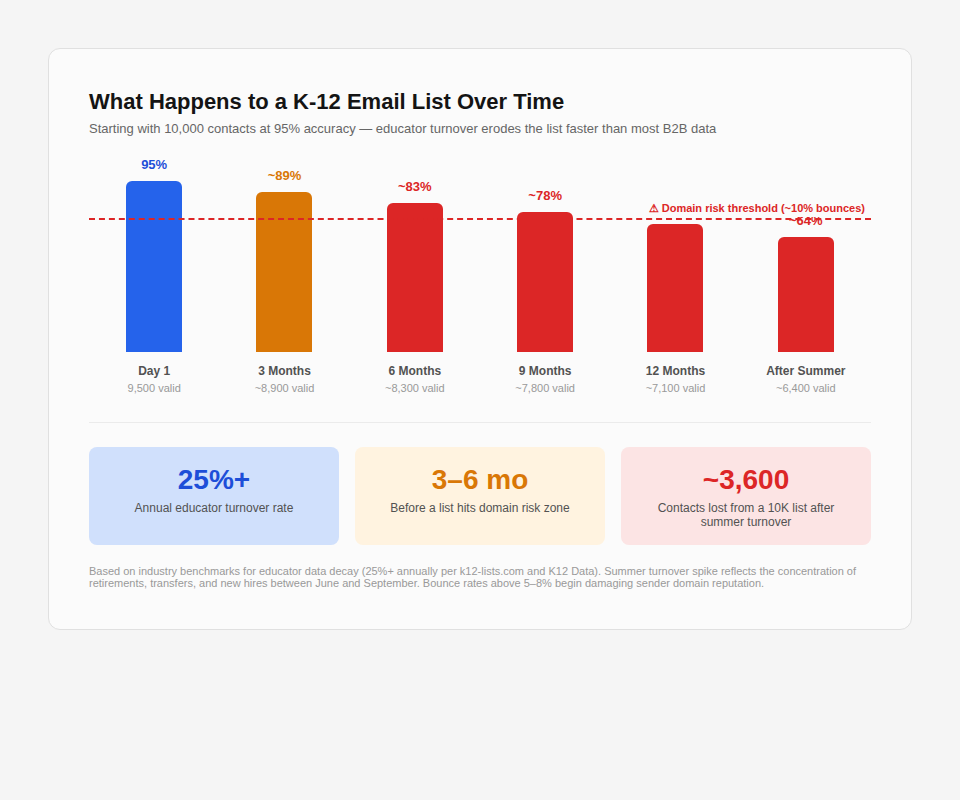
Path 1: They buy a K-12 email list. There are a handful of vendors that sell school contact databases — K12 Prospects, MCH Strategic Data, SchoolDataLists, and others. These lists can be useful as a starting ingredient, but they come with real problems. Bounce rates of 10-15% are common because educator contact data decays fast — one study pegged annual turnover above 25%. A 15% bounce rate doesn't just waste emails. It damages your sending domain, which means your next campaign performs worse too.
And even a "good" purchased list gives you names and emails. It doesn't tell you which schools are actively looking for what you sell, which districts have budget allocated, or which principals just took over a new school and are re-evaluating vendors. Raw contact data without signal data is like having a phone book — technically useful, practically overwhelming.
Path 2: They tell their SDR to figure it out. The SDR spends weeks manually searching district websites, scrolling through school staff pages, copying names into spreadsheets. They might find 200-300 contacts in a month of full-time work. Meanwhile, they're supposed to also be writing emails, managing sequences, and handling replies. The math just doesn't work — and the SDR burns out or gets reassigned. (We broke down the full cost comparison of hiring an SDR vs. outsourcing outbound — and for K-12 specifically, the gap is even wider because of the sourcing bottleneck.)
Both paths lead to the same conclusion: "Outbound doesn't work for selling to schools." But outbound isn't the problem. The sourcing is.
Why Cold Email to Schools Actually Outperforms Most B2B Outreach
Here's the part that surprises people: when the contact sourcing is solved, the data suggests K-12 email outreach outperforms most B2B sectors — and by a meaningful margin.
Start with the email marketing benchmarks. Mailchimp's data (drawn from billions of emails) puts Education & Training at a 35.64% open rate — compared to 31.35% for Business & Finance and 29.81% for Ecommerce. Ed2Market's K-12-specific benchmarks are even higher: 37.35% open rate with a 2.56% click-through rate. Education consistently leads most B2B verticals in email engagement by 5-8 percentage points.
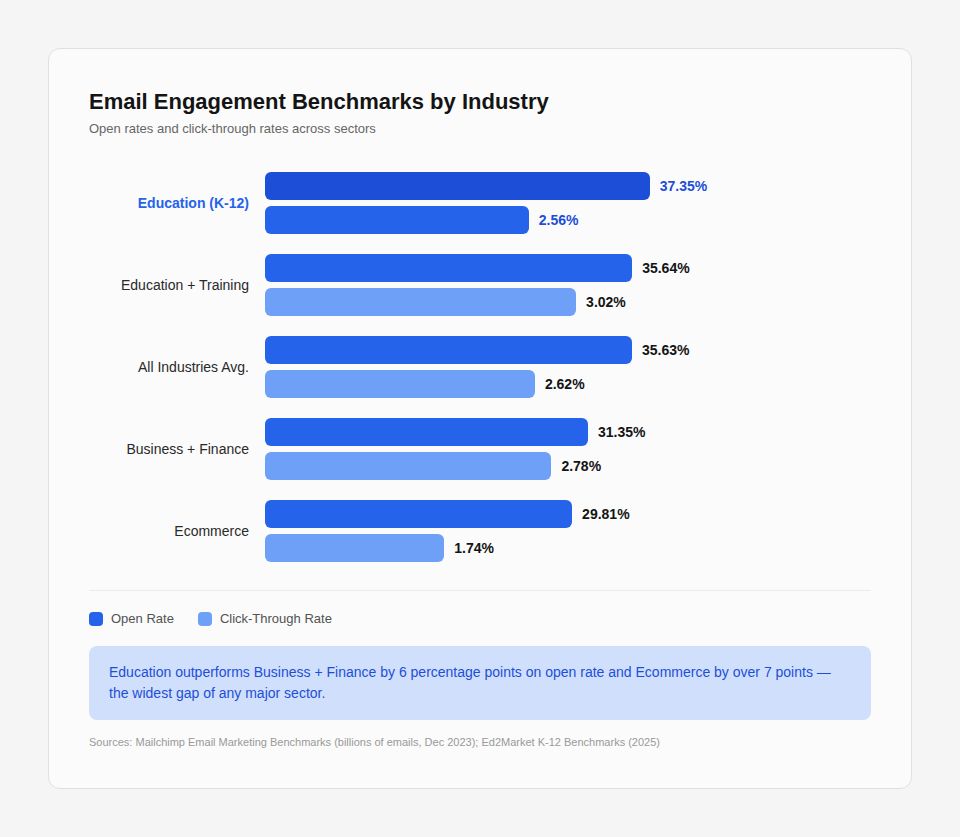
Now, those are marketing email benchmarks — not cold outbound. But the pattern holds for a structural reason: fewer senders can reach these buyers in the first place.
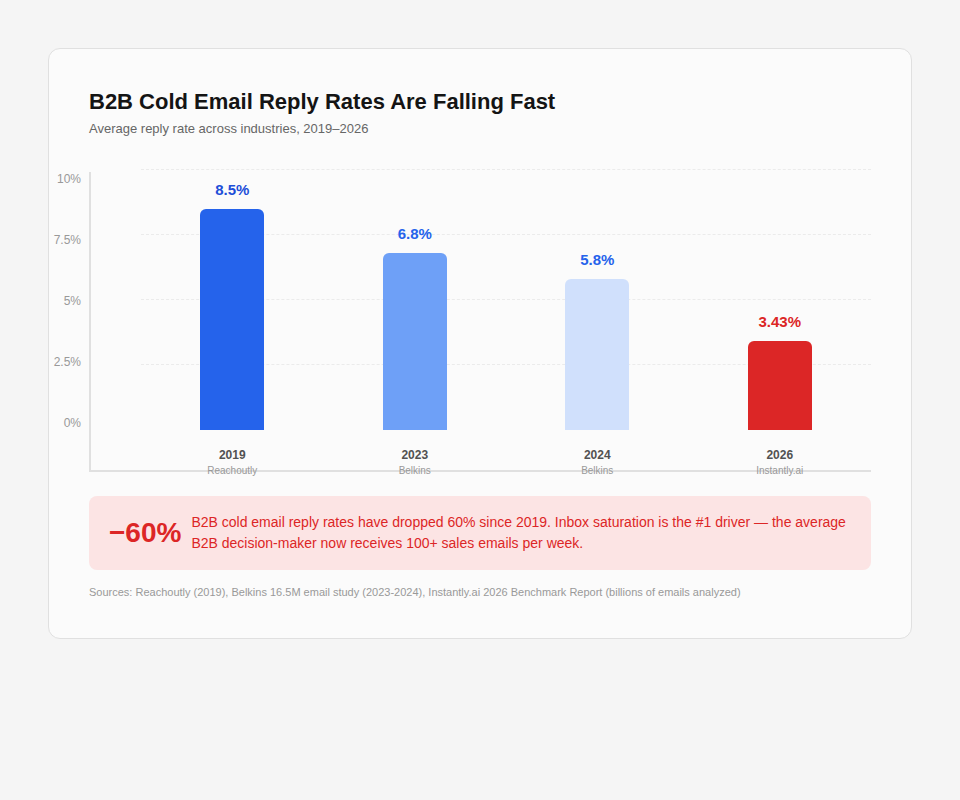
In standard B2B, the inbox saturation problem is well-documented. Instantly.ai's 2026 benchmark report (analyzing billions of cold emails) shows the average reply rate has fallen to 3.43%. Belkins' study of 16.5 million emails found reply rates dropped from 6.8% in 2023 to 5.8% in 2024. The trend is clear — B2B decision-makers receive 100+ sales emails per week (per SalesMotion and Gartner-cited research), and they've built a reflex: scan, delete, scan, delete.
School administrators get vendor emails too — an EdWeek Research Center survey of 400+ district and school leaders found that nearly half receive 21-100 vendor emails per week. That's not an empty inbox. But here's the critical difference: almost all of those emails come from marketing blasts by list providers, not targeted cold outbound from companies that did actual research on the school. The barrier to reaching these buyers with personalized cold email is so high — because the contacts aren't in any standard sales database — that very few companies manage to do it at all.
That's the real advantage. It's not that school inboxes are empty. It's that the cold outbound channel specifically is dramatically less crowded, because most companies can't get past step one.
We've seen this play out in practice. When we ran campaigns for a national school supply provider, we sourced over 30,000 verified K-12 contacts in two months — principals, school administrators, procurement leads, even PTO/PTA contacts. We started with a 2,500-school pilot. The response rates were well above what we typically see in traditional B2B verticals, and we've generated over 200 positive responses and growing. When a well-researched email lands in a principal's inbox referencing something specific about their school or district, it stands out — because they're simply not used to getting that kind of outreach.
The channel works. The bottleneck was always access to the contacts.
What "Solving the Sourcing" Actually Looks Like
Standard B2B databases don't index schools because schools don't fit the standard data model. So you have to go find the contacts yourself.
For public schools, every state publishes education directories — lists of schools, districts, and administrators. Some states give you clean CSV downloads. Others bury the data in PDFs that haven't been redesigned since 2008. District websites list staff pages, but the format varies wildly — some have every administrator's email on a public page, others require you to dig through three layers of navigation to find anyone.
Private schools are a different challenge. They don't appear in state education directories the same way (or at all, in some states). You're often sourcing contacts from individual school websites, association directories like NAIS or state-level private school associations, and religious denomination networks. The data is more fragmented, but the upside is that private school decision-making is usually faster and involves fewer stakeholders — the head of school or principal often has direct purchasing authority.
The work is building a systematic process to pull contacts from these public and institutional sources, verify the emails, cross-reference for accuracy, and organize them by the buyer roles that actually matter for your product. It's not technically difficult in any single step. It's operationally intensive because every state, every district, every school is slightly different. (The underlying principles — research-first targeting, personalization, and plain-text messaging — are the same as any good cold email campaign. The difference is where the data comes from.)
This is the kind of work that doesn't make sense for an internal SDR to do. It's a research and data operation, not a sales activity. And it's exactly the kind of work that a general-purpose lead gen agency will struggle with because they've built their entire workflow around Apollo and ZoomInfo.
For companies selling to schools, the contact sourcing is the competitive moat. If you can reach 5,000 verified principals in your target states and your competitor can only reach 500, you're not playing the same game.
The Budget Cycle Matters More Than You Think
Even with good contacts, timing kills a lot of K-12 campaigns — especially when you're selling at the district level. Public school districts plan their budgets between March and June for the following school year. If you're launching outbound in October targeting superintendents or district procurement, you're reaching people who have already allocated their budget and can't buy until next spring.
The best time to run district-level outbound is January through May — early enough that you're part of the budget planning conversation, but not so early that you're forgotten by the time purchasing starts.
School-level purchasing works on a different rhythm. Principals and department heads often have discretionary budgets they can spend throughout the year, especially for smaller purchases — classroom supplies, supplemental programs, safety equipment, professional development. For these sales, back-to-school season (August-September) and mid-year (January-February) tend to be strong windows. The buying process is faster and involves fewer stakeholders.
Private schools are more flexible still. Without the rigid district budget cycle, heads of school can often make purchasing decisions year-round. The trade-off is that private schools tend to have smaller budgets per school.
This catches a lot of companies off guard. They launch outbound in Q4 targeting district buyers, see mediocre results, and conclude the channel doesn't work. It's not the channel — it's the calendar. Matching your outreach timing to how your specific buyer actually purchases makes a real difference.
Who This Works For (And Who It Doesn't)
Cold email outbound to schools works best when a few things are true:
Your product or service is relevant to people who make or influence purchasing decisions — superintendents, principals, curriculum directors, district IT directors, procurement leads, heads of school at private institutions, or department-level decision-makers. These are the people who respond to cold email. Teachers generally don't — they influence purchases but rarely have buying authority.
The economics support outbound. For district-level sales, that typically means $10K+ deal sizes — the kind of contracts that justify the research and personalization that makes cold email work. For school-level sales (where a principal or department head can buy directly), the threshold is lower, but you still need enough margin per deal that a campaign generating 5-15 meetings a month moves the needle.
You have someone who can take the meetings. Outbound generates conversations, not closed deals. Someone at your company needs to be available for 30-minute calls with interested administrators — whether that's a founder, a sales rep, or an account executive.
You're willing to commit to a 2-3 month timeline. Infrastructure setup takes about two weeks. Warmup and initial sending takes another two. First real responses show up in weeks 4-5. Expecting results in week one is a recipe for disappointment.
If those boxes are checked, cold email to schools — public and private — is one of the highest-ROI outbound channels we've worked with. Precisely because so few companies have figured out the contact sourcing.
The Takeaway
Outbound to schools doesn't fail because the channel is wrong. It fails because the standard B2B playbook — buy a database, hire an SDR, send emails — doesn't work when the buyers aren't in any database.
The companies that figure out contact sourcing have a massive advantage. They're reaching decision-makers in inboxes that aren't flooded with vendor pitches. They're landing meetings with administrators who actually have budget and authority. And they're doing it in a market where most of their competitors are still relying on conferences, referrals, and hope. (This is the same dynamic we see across all professional services verticals — the firms that build a predictable outbound motion gain a structural edge over those still waiting for the phone to ring.)
The contact sourcing is the hard part. Once that's solved, everything else is just good outbound fundamentals.
Selling to schools but can't find the buyers? Book a 30-minute call — we'll map your K-12 market and show you what's working.